Today, the question “What is eye tracking?” is frequently researched, especially in the fields of user experience, neuromarketing, and digital analytics. At NeuroPiq, we professionally provide methods for tracking and analyzing users’ eye movements, helping brands and researchers make more informed decisions. In this article, we explain in detail what eye tracking is, how it works, and in which industries it is used.
What Does Eye Tracking Mean?
To answer the question “What is eye tracking?”, it is a set of advanced technologies and methods used to measure eye movements, gaze direction, and fixation points. These systems record where users look, how long they look at specific areas, and in what sequence their gaze moves, helping researchers better understand user behavior.
Eye tracking data is particularly important in digital marketing, neuromarketing, and user experience (UX) studies.
Component | Description |
|---|---|
Eye Tracking Devices | Sensors that detect eye position and record gaze data. |
Infrared Light Systems | Illuminate the eye and corneal reflections to help determine gaze position accurately. |
Data Collection and Analysis Software | Converts gaze points, fixation durations, and movement sequences into meaningful data. |
Reporting and Visualization | Presents eye movements visually through heatmaps, gaze plots, charts, or animations. |
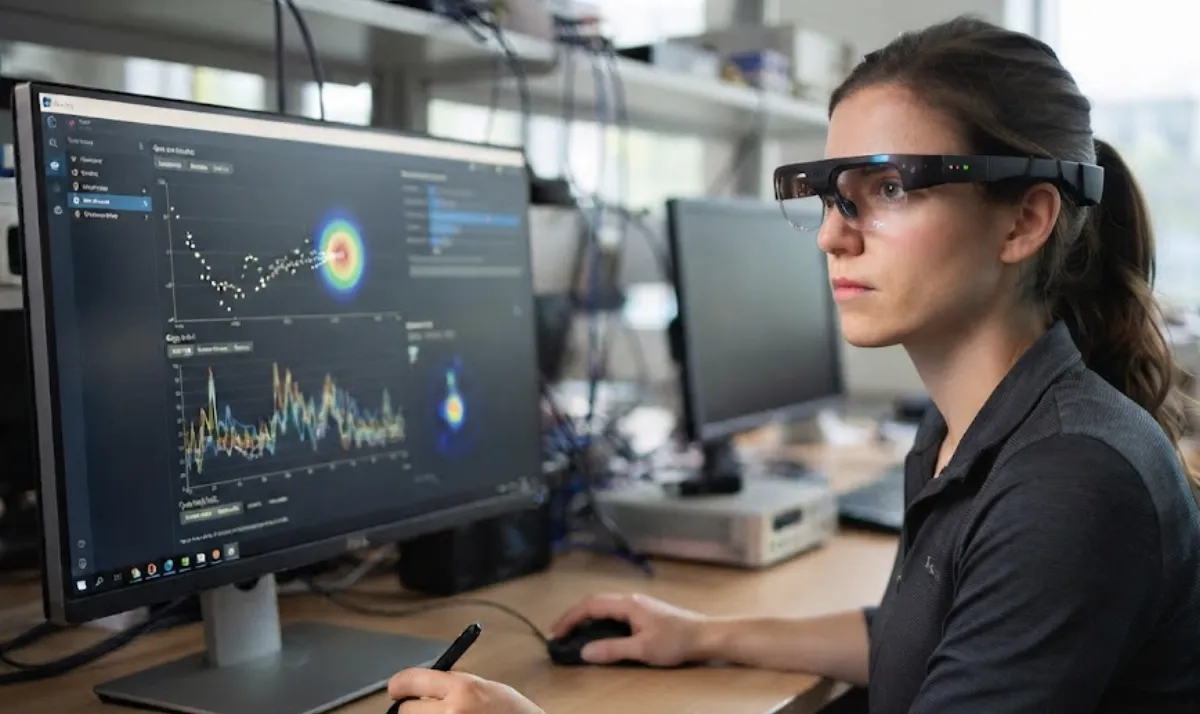
In general, eye tracking devices use infrared light and cameras to determine eye position and gaze direction. This makes it possible to analyze users’ attention, interest, and visual behavior in both digital and physical environments.
How Does Eye Tracking Work?
The question “What is eye tracking?” can also be answered by examining how the technology works. Eye tracking measures and analyzes a person’s eye movements, gaze direction, and fixation points. These systems are used to improve user experience, optimize marketing strategies, and support data-driven product design decisions.
The process generally consists of three main stages:
1. Eye Tracking
Eye tracking devices use infrared light and high-resolution cameras to monitor the eyes accurately.
Infrared illumination helps detect reflections from the cornea and other eye structures to estimate gaze direction and eye position.
This allows the system to track in real time which part of a screen or environment the user is looking at and how their gaze moves.
2. Data Collection
The system records raw data generated by eye movements.
This data may include fixation duration, gaze sequence, repeated eye movements, and areas that are skipped.
The collected data is transferred to software platforms for storage and detailed analysis.
Eye movements can also be compared under different experimental conditions.
3. Analysis and Visualization
The collected data is visualized to help interpret user behavior.
Heatmaps, gaze plots, charts, and animated gaze paths are commonly used.
Heatmaps show areas receiving greater visual attention through color intensity. For example, warmer colors generally indicate higher levels of attention.
These analyses can support decisions related to website design, advertising campaigns, product placement, and physical environment layouts.
Eye tracking analysis also provides valuable data for measuring and improving design effectiveness in user experience (UX) research.
An eye tracking system records where the user looks, how long they focus on a particular area, and the sequence of their eye movements. This process helps businesses and designers understand real user behavior and develop more effective solutions based on measurable data.

What Are the Uses of Eye Tracking?
The answer to “What is eye tracking?” becomes clearer when its practical applications are considered. By measuring eye movements, gaze direction, and fixation points, eye tracking systems support data-driven decision-making across different industries.
Common areas of use include:
Digital Marketing: Analyzes user attention and interaction across websites, applications, and advertising campaigns.
Neuromarketing: Examines consumer attention and visual behavior to support marketing strategy optimization.
Education and Research: Tracks attention patterns and learning behavior.
Healthcare and Rehabilitation: Eye movement data may be used in certain neurological assessments and research-based rehabilitation applications.
At NeuroPiq, we provide eye tracking solutions tailored to different industries to support data-driven strategic decisions and user experience optimization.
What Are the Different Types of Eye Tracking?
To better understand what eye tracking is, it is also useful to examine the different methods used.
Eye Tracking Type | Description | Advantages |
|---|---|---|
Remote Eye Tracking | Tracks eye movements through sensors positioned away from the user, without requiring a wearable device. | Allows data collection in a relatively natural setting and reduces the impact of wearable equipment on user behavior. |
Head-Mounted Eye Tracking | Uses glasses or head-mounted devices to directly measure eye movements. | Suitable for complex visual environments, interactive experiences, and real-world tasks. |
Mobile Eye Tracking | Uses portable eye tracking systems to analyze gaze behavior in real-life environments. | Useful for studying real-world behavior, movement, retail environments, and outdoor experiences. |
These methods are selected according to the research environment, user behavior being studied, and the type of data required.
What Are the Advantages of Eye Tracking Analysis?
After answering “What is eye tracking?”, it is important to understand the benefits provided by the resulting data.
Eye tracking offers valuable insights into user behavior and can provide significant advantages in several areas.
User-Centered Design
Eye tracking data allows product and service designs to be evaluated based on actual user behavior. By identifying which elements attract attention and which areas are overlooked, interfaces, products, and campaign designs can be improved.
Data-Driven Decision-Making
By analyzing eye movements and fixation durations, researchers can identify which content or areas receive more visual attention. This supports strategic decisions based on measurable data rather than subjective assumptions.
Sales and Marketing Performance
Eye tracking can be used to evaluate how users interact with advertisements and campaigns. Visual attention maps and gaze paths help identify which elements attract attention and which areas may need improvement.
These insights can then support the optimization of marketing strategies and advertising materials.
Education and Learning Analysis
When eye tracking data is collected while users interact with educational materials, researchers can examine attention duration and fixation points.
This information can contribute to the development of clearer, more effective, and more user-friendly educational content.
These advantages demonstrate why eye tracking technology is important in marketing, design, education, and user experience research. Measurable data obtained from eye movements can support more reliable strategic decisions.
Why Is Eye Tracking Technology Important?
The answer to “What is eye tracking?” becomes even clearer when considering the insights the technology provides.
Understanding visual behavior helps brands determine whether important content, messages, or design elements are actually being noticed by users. Eye tracking can also provide rapid feedback that supports testing and optimization processes.
At NeuroPiq, we analyze user behavior through eye tracking solutions and help businesses make data-driven decisions.
To collect and analyze the right data for your projects, you can contact the NeuroPiq expert team.